
Sheet Metal Bend Calculator
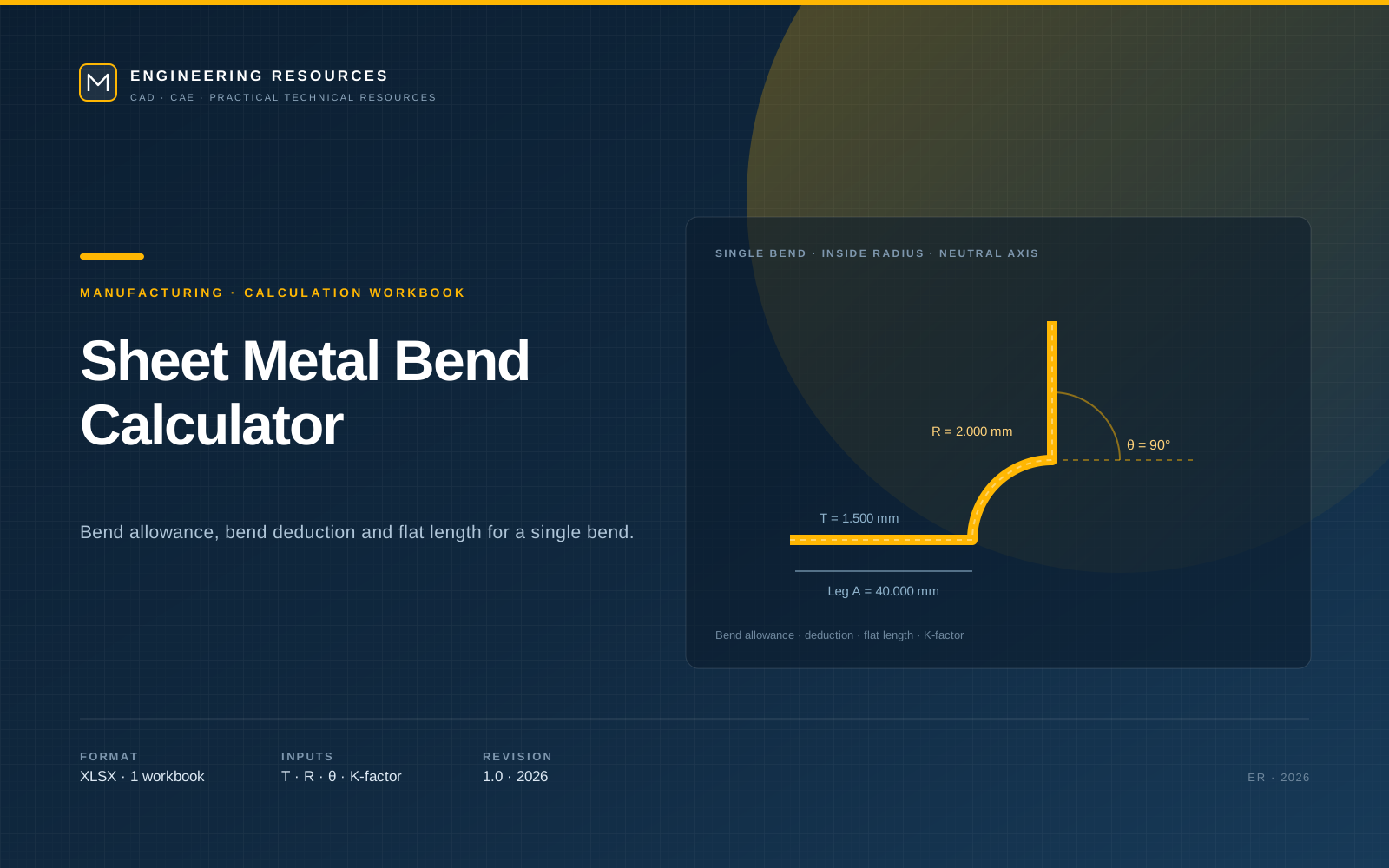
Bend allowance, bend deduction and flat length for a single bend.
About this resource
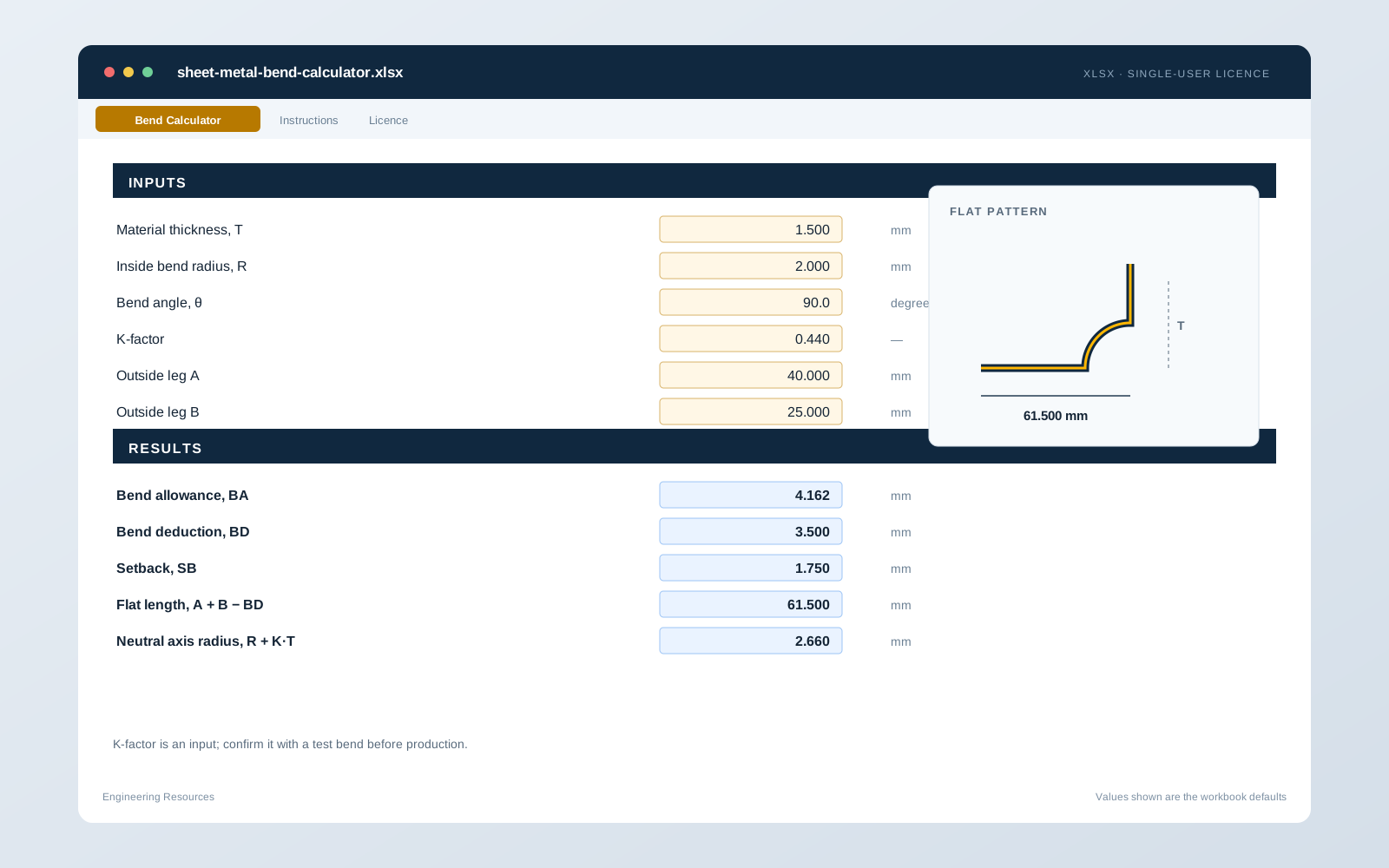
This workbook calculates the flat pattern for a single bend from the material thickness, inside bend radius, bend angle and K-factor. It returns bend allowance, bend deduction, setback, outside setback, neutral-axis radius and the flat length for two outside leg dimensions.
A reference table gives indicative K-factor ranges for cold-rolled steel, stainless steel, aluminium and copper alloys, with a clear note that the value must be confirmed by a test bend or the material supplier.
The calculator is intended for estimating and checking flat patterns before production. Springback, material thinning, multi-bend parts and tooling-specific behaviour are outside its scope and must be handled in the CAM or nesting workflow.
What is included
- Sheet Metal Bend Calculator — XLSX · Single-bend calculator with input cells, bend results, K-factor reference table, assumptions, unit notes, instructions and licence sheets. · Editable
- Bend allowance, bend deduction, setback and outside setback
- Flat length from two outside leg dimensions
- Neutral-axis radius and angle in radians
- Indicative K-factor ranges for common materials
- Assumptions, unit notes, instructions and licence sheets
Software compatibility
- Microsoft Excel: Excel 2016 or later, desktop or Microsoft 365 · required · edit · tested by author — Uses standard trigonometric and conversion functions.
- LibreOffice Calc: 7.6 or later · optional · edit · format based expectation — Opens normally; confirm the printed layout before production use.
Prerequisites and technical context
Intended audience
working-engineer, engineering-team, early-career-engineer
Prerequisites
- Material thickness and inside bend radius from the drawing or tooling
- A K-factor for the material and process, confirmed by test bend where possible
Unit systems
- Metric: mm and degrees
Assumptions
- Single bend with constant thickness and constant inside radius
- Bend angle below 180°
- Flat length measured along the neutral axis
- K-factor represents the neutral-axis position for the material and process
- Springback and material thinning are not modelled
Technical notes
- Bend allowance = θ (rad) × (R + K·T).
- Bend deduction = 2 (R + T) tan(θ/2) for angles below 180°.
- Flat length = outside leg A + outside leg B − bend deduction.
- For multi-bend parts, calculate each bend and subtract each bend deduction once.
References
- No external standards or references listed.
Scope and limitations
Included
- Bend allowance, bend deduction, setback and outside setback
- Flat length from two outside leg dimensions
- Neutral-axis radius and angle in radians
- Indicative K-factor ranges for common materials
- Assumptions, unit notes, instructions and licence sheets
Not included
- Multi-bend parts and bend sequencing
- Springback compensation and tooling selection
- Material thinning, cracking and minimum bend radius limits
- CAM programming, nesting and laser or punch path generation
- Production approval of a flat pattern
Limitations
- The result depends on the K-factor, which varies with material, temper, tooling and die width.
- Confirm the K-factor with a test bend or the material supplier before releasing a flat pattern.
- Do not use the calculator as the only check for safety-critical formed parts.
Author and review information
Author / publisher: Engineering Resources
Review status: Author checked
The bend geometry follows the standard neutral-axis formulation used in sheet-metal practice. K-factor ranges are indicative values compiled for common materials and processes, not certified tooling data.
Review scope: Formulas, worked defaults and stated assumptions were checked against the classical equations named on each sheet. No independent third-party review was commissioned.
Licence and permitted use
Single-user commercial licence
One named user may use this resource on any number of their own devices for commercial and educational engineering work. Resale, redistribution, publication, sublicensing and inclusion in a paid course or product are not permitted. Adapted copies remain subject to the same terms.
- Use on your own projects, including paid client work
- Use for teaching and internal training
- Adapt the formulas and layout for your own internal templates
- Keep a personal or company archive copy for business continuity
Not permitted
- Reselling, sublicensing or distributing the file
- Publishing the file on a website, shared drive or marketplace
- Including the file in a paid course, product or template pack
- Removing the licence, attribution or version notices
Delivery
Orders are confirmed by email before payment. After payment clears, the workbook is sent as a secure download link with the licence and a short getting-started note. Usually within one business day.