
CFD Mesh Quality Checklist
A ten-page pre-solve review for surface, boundary layer and volume mesh quality.
About this resource
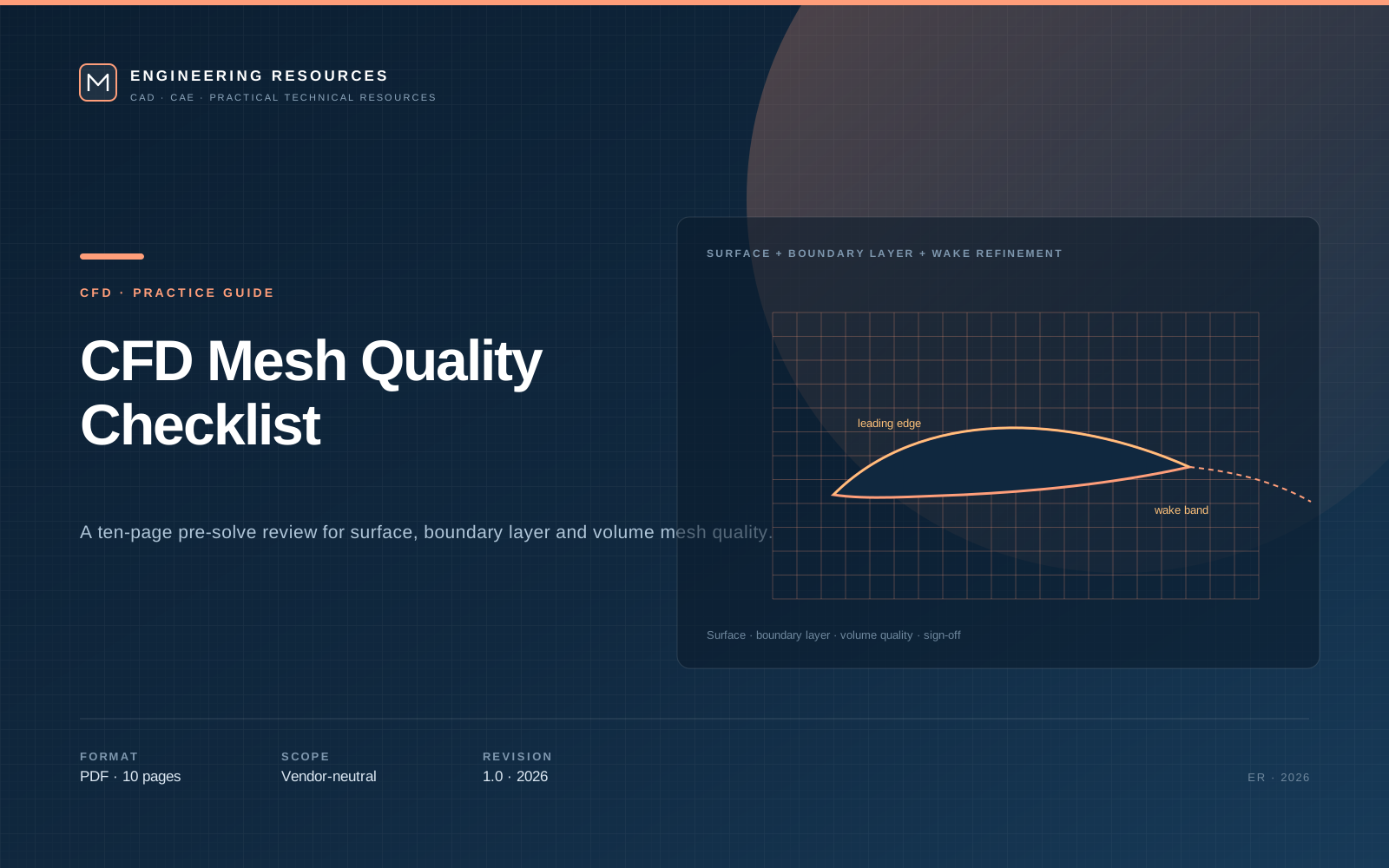
This ten-page checklist gives CFD analysts a consistent way to review a mesh before a solve. It covers the fluid domain and geometry, surface mesh closure and quality, boundary-layer height and coverage, volume mesh metrics, physics alignment and solver readiness.
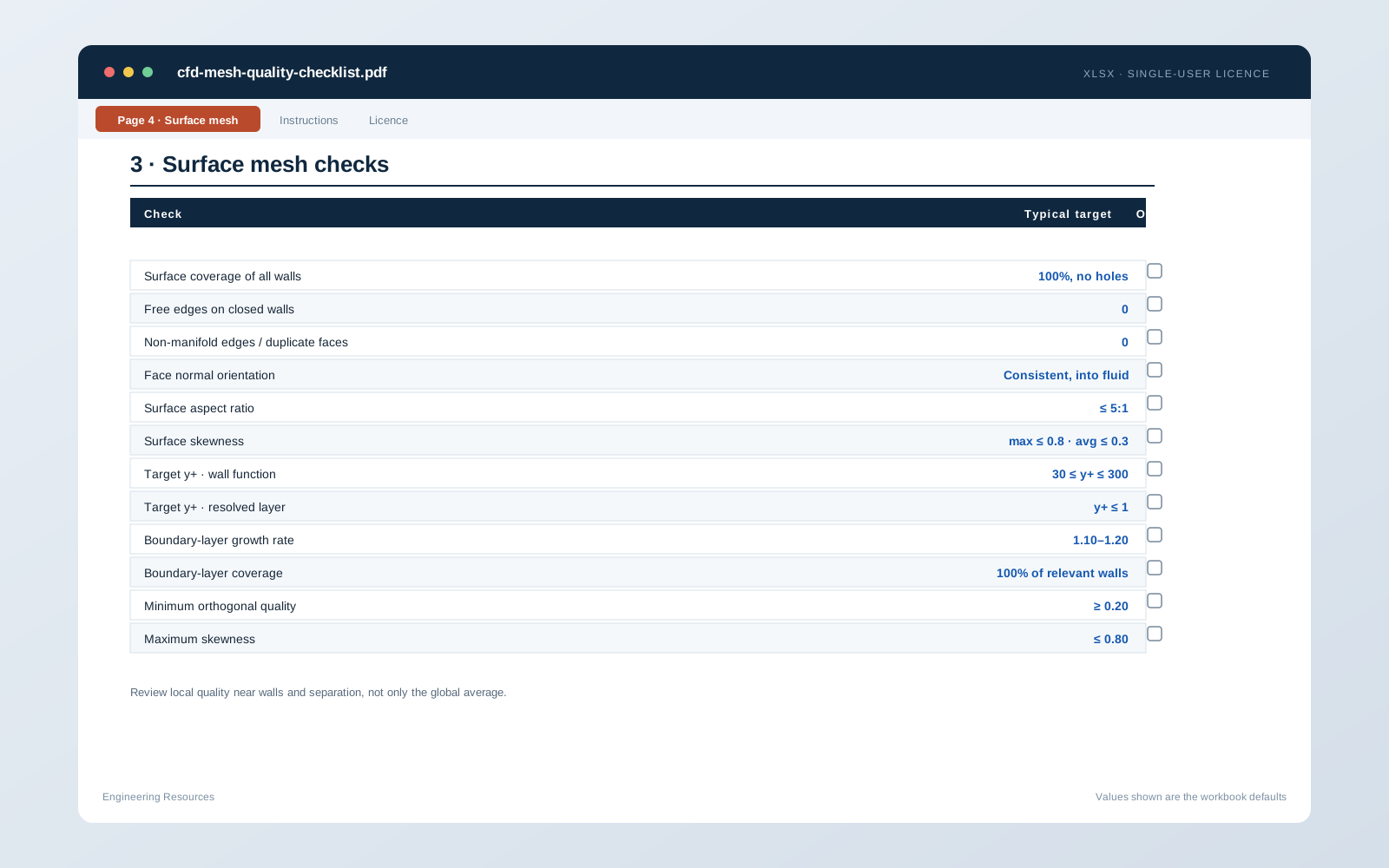
Each section lists the checks, typical acceptance values and space to record the actual result and the corrective action. A quality metric reference explains what orthogonal quality, skewness, aspect ratio, Jacobian ratio, y+ and growth rate measure, and why each one matters.
The final pages provide a mesh review record, a corrective-action log, a sign-off block, the assumptions and limitations, and the licence. It is written to be used on a real project, not read once and filed away.
The checklist is vendor-neutral and applies to general-purpose finite-volume CFD. Target values are common engineering practice, not universal acceptance criteria; always follow the solver vendor's guidance and support any decision with a mesh independence study.
What is included
- CFD Mesh Quality Checklist — PDF · Ten-page A4 PDF with nine review sections, quality metric reference, mesh review record, corrective-action log and sign-off block. · Not editable
- Geometry and fluid-domain checks
- Surface mesh coverage, closure, normals and quality
- Boundary-layer height, growth, coverage and y+
- Volume mesh orthogonal quality, skewness, aspect ratio and Jacobian
- Physics alignment and solver-readiness checks
- Quality metric reference, review record, corrective-action log and sign-off
Software compatibility
- PDF reader: Any current PDF reader on desktop or mobile · required · view · format based expectation — Text is selectable and the pages print on A4 without scaling.
Prerequisites and technical context
Intended audience
working-engineer, engineering-team, early-career-engineer, student
Prerequisites
- Basic familiarity with finite-volume CFD
- A mesh that can be inspected in the meshing tool or solver
Unit systems
- SI and dimensionless metrics
Assumptions
- General-purpose finite-volume CFD
- Cell-centred or vertex-centred solver
- Target values are common engineering practice, not universal acceptance criteria
- Vendor-specific metric definitions may differ
Technical notes
- Wall-function models typically need 30 ≤ y+ ≤ 300; resolved boundary layers need y+ ≤ 1.
- Boundary-layer growth rates of 1.10–1.20 are common practice.
- Orthogonal quality and skewness definitions vary between vendors; record the tool and version used.
- A mesh independence study is the only direct evidence that a mesh is adequate for a result.
References
- No external standards or references listed.
Scope and limitations
Included
- Geometry and fluid-domain checks
- Surface mesh coverage, closure, normals and quality
- Boundary-layer height, growth, coverage and y+
- Volume mesh orthogonal quality, skewness, aspect ratio and Jacobian
- Physics alignment and solver-readiness checks
- Quality metric reference, review record, corrective-action log and sign-off
Not included
- Boundary-condition selection and verification
- Material data and turbulence model selection
- Convergence monitoring and validation
- A mesh independence study or uncertainty quantification
- Software-specific step-by-step instructions
Limitations
- Target values are guidance, not a substitute for vendor documentation or project requirements.
- A mesh that passes every metric can still produce a wrong answer.
- Use the checklist as a review record, not as certification of accuracy.
Author and review information
Author / publisher: Engineering Resources
Review status: Author checked
The checklist was assembled from established CFD mesh-review practice. Metric definitions and target ranges were cross-checked between common finite-volume solver conventions and are presented as guidance rather than universal limits.
Review scope: Formulas, worked defaults and stated assumptions were checked against the classical equations named on each sheet. No independent third-party review was commissioned.
Licence and permitted use
Single-user commercial licence
One named user may use this resource on any number of their own devices for commercial and educational engineering work. Resale, redistribution, publication, sublicensing and inclusion in a paid course or product are not permitted. Adapted copies remain subject to the same terms.
- Use on your own projects, including paid client work
- Use for teaching and internal training
- Adapt the formulas and layout for your own internal templates
- Keep a personal or company archive copy for business continuity
Not permitted
- Reselling, sublicensing or distributing the file
- Publishing the file on a website, shared drive or marketplace
- Including the file in a paid course, product or template pack
- Removing the licence, attribution or version notices
Delivery
Orders are confirmed by email before payment. After payment clears, the PDF is sent as a secure download link with the licence. Usually within one business day.