
Beam Analysis Workbook
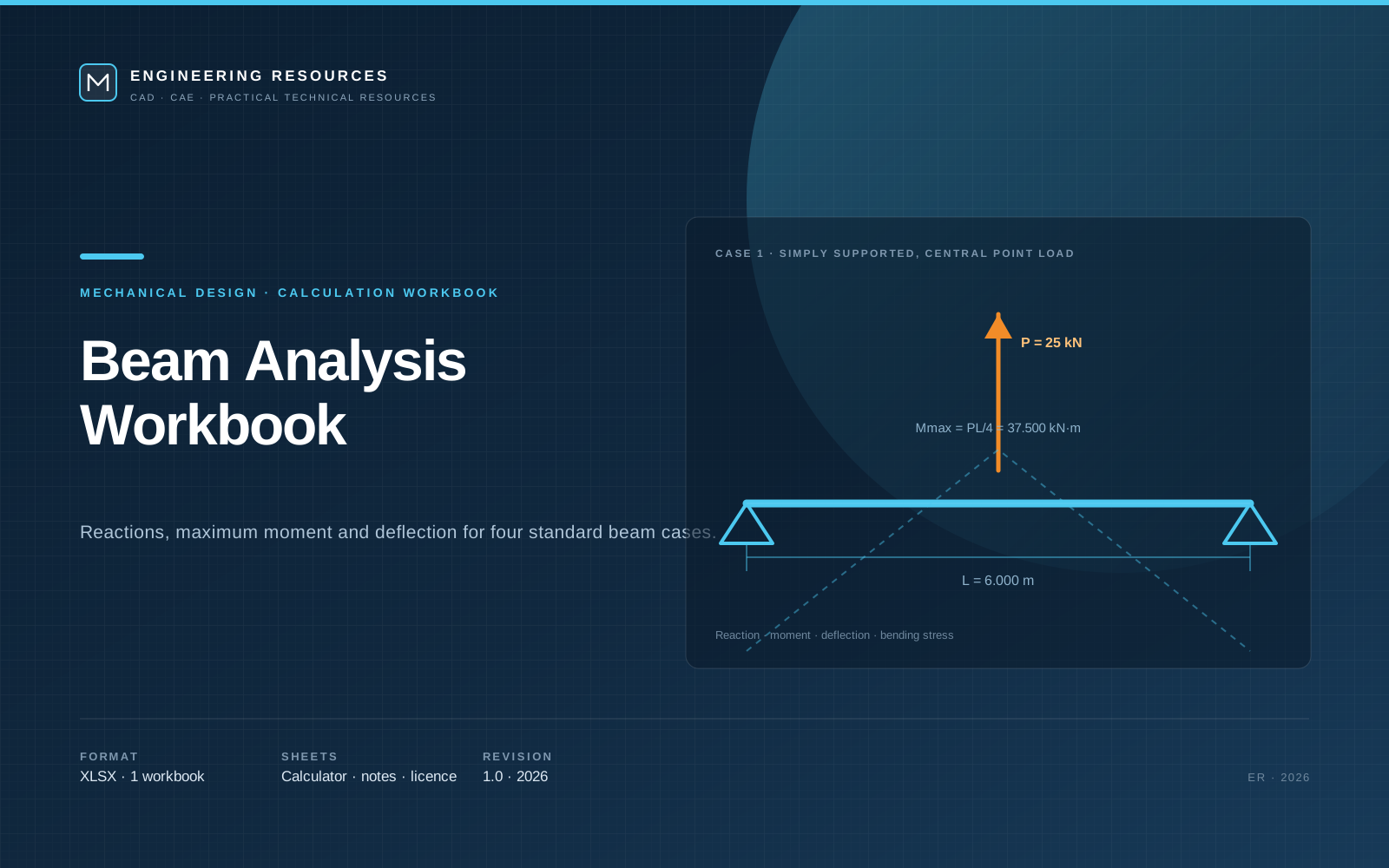
Reactions, maximum moment and deflection for four standard beam cases.
About this resource
This workbook covers the four beam cases that appear most often in preliminary mechanical and structural design: a simply supported beam with a central point load, a simply supported beam with a uniform load, a cantilever with an end point load, and a cantilever with a uniform load.
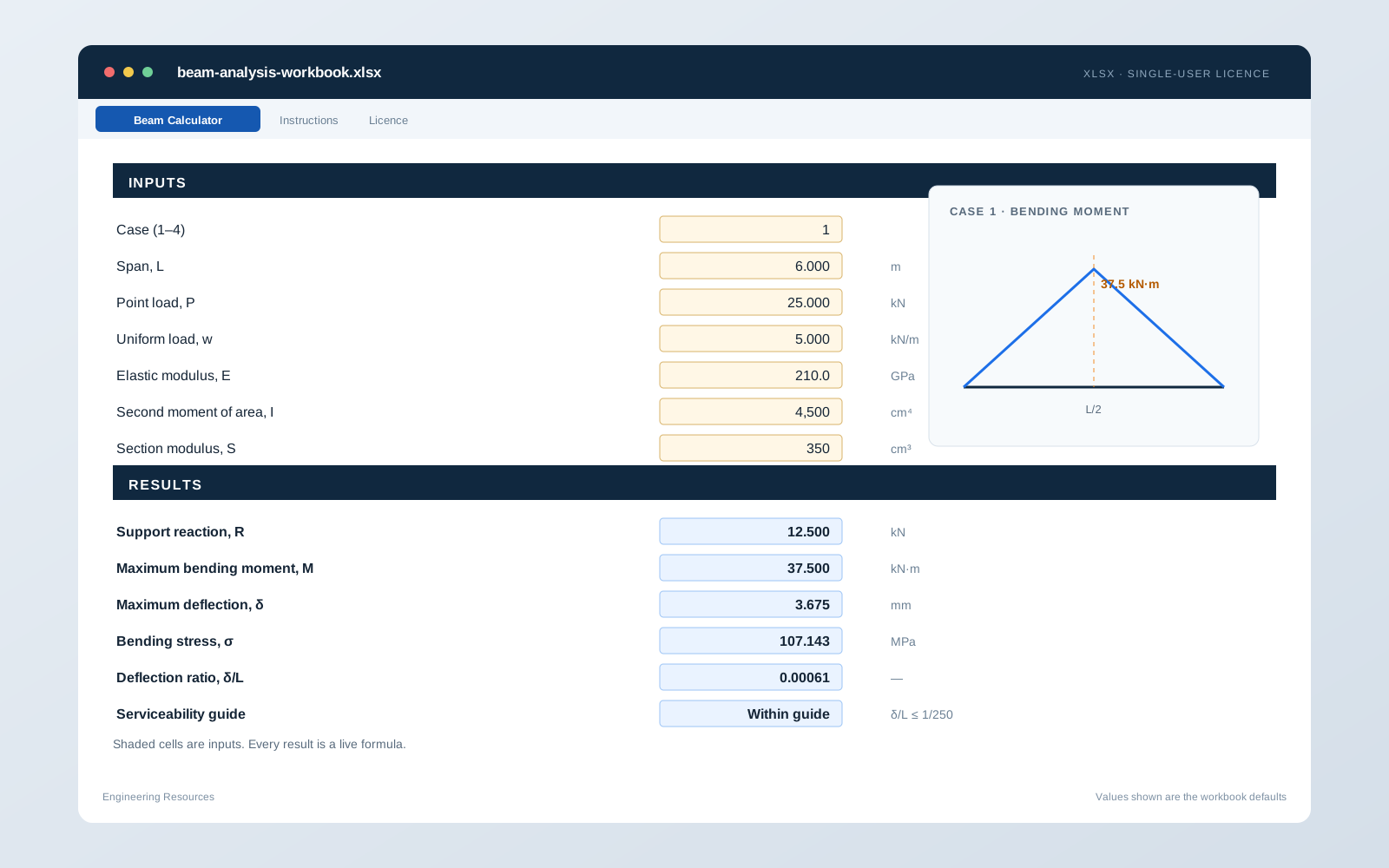
Select the case, enter the span, loading and section properties, and the sheet updates the support reaction, maximum bending moment, maximum deflection, bending stress and deflection ratio. A serviceability check compares the result with a 1/250 span guide.
A formula reference on the calculator sheet shows the equation used for every case, so the result can be checked by hand. The assumptions and unit-handling notes state exactly where the formulas apply and how the unit conversions are performed.
The workbook is intended for preliminary sizing, checking and study. It is not a substitute for a frame analysis program, a code check or independent review for safety-related work.
What is included
- Beam Analysis Workbook — XLSX · Calculator sheet with case selector, input cells, live results, formula reference, assumptions and unit notes, plus instructions and licence sheets. · Editable
- Four standard beam cases with a case selector
- Support reaction, maximum moment and maximum deflection
- Bending stress from an optional section modulus
- Deflection ratio and a 1/250 serviceability guide
- Formula reference, assumptions, unit notes, instructions and licence sheets
Software compatibility
- Microsoft Excel: Excel 2016 or later, desktop or Microsoft 365 · required · edit · tested by author — Formulas use standard worksheet functions only.
- LibreOffice Calc: 7.6 or later · optional · edit · format based expectation — The .xlsx file opens normally; check the layout before sharing a printed copy.
Prerequisites and technical context
Intended audience
early-career-engineer, working-engineer, engineering-team, student
Prerequisites
- Basic understanding of bending moment and deflection
- Section properties for the member being checked
Unit systems
- SI: m, kN, kN/m, GPa, cm⁴, cm³, MPa, mm
Assumptions
- Linear elastic, isotropic, homogeneous material
- Euler–Bernoulli bending with small deflections
- Prismatic section with constant E and I
- Loads applied in the plane of bending
- No axial load, torsion, shear deformation, self-weight or support settlement
- Deflection formulas apply to the stated load position only
Technical notes
- E is entered in GPa and converted internally to kN/m² by multiplying by 10⁶.
- I is entered in cm⁴ and converted to m⁴ by multiplying by 10⁻⁸.
- Deflection is displayed in millimetres; stress uses M × 10³ / S with M in kN·m and S in cm³, giving N/mm² (MPa).
- The 1/250 span guide is a common serviceability reference, not a code requirement for every project.
References
- No external standards or references listed.
Scope and limitations
Included
- Four standard beam cases with a case selector
- Support reaction, maximum moment and maximum deflection
- Bending stress from an optional section modulus
- Deflection ratio and a 1/250 serviceability guide
- Formula reference, assumptions, unit notes, instructions and licence sheets
Not included
- Continuous beams, frames and indeterminate structures
- Moving, partial or asymmetric loads
- Shear deformation, torsion and axial load interaction
- Connection design, buckling checks and code compliance
- Finite element analysis or model generation
Limitations
- Results are only valid inside the stated linear-elastic, small-deflection assumptions.
- The workbook does not select a section or approve a design.
- Verify any safety-related result against hand calculations or validated software before use.
Author and review information
Author / publisher: Engineering Resources
Review status: Author checked
Equations were taken from classical Euler–Bernoulli beam theory and implemented as transparent worksheet formulas. Default values form a complete worked example that can be checked by hand.
Review scope: Formulas, worked defaults and stated assumptions were checked against the classical equations named on each sheet. No independent third-party review was commissioned.
Licence and permitted use
Single-user commercial licence
One named user may use this resource on any number of their own devices for commercial and educational engineering work. Resale, redistribution, publication, sublicensing and inclusion in a paid course or product are not permitted. Adapted copies remain subject to the same terms.
- Use on your own projects, including paid client work
- Use for teaching and internal training
- Adapt the formulas and layout for your own internal templates
- Keep a personal or company archive copy for business continuity
Not permitted
- Reselling, sublicensing or distributing the file
- Publishing the file on a website, shared drive or marketplace
- Including the file in a paid course, product or template pack
- Removing the licence, attribution or version notices
Delivery
Orders are confirmed by email before payment. After payment clears, the workbook is sent as a secure download link with the licence and a short getting-started note. Usually within one business day.